The Quiet Economy Behind the Household Names
Arkansas's best-known companies trade on public exchanges. The carriers, processors and suppliers growing fastest around them do not.
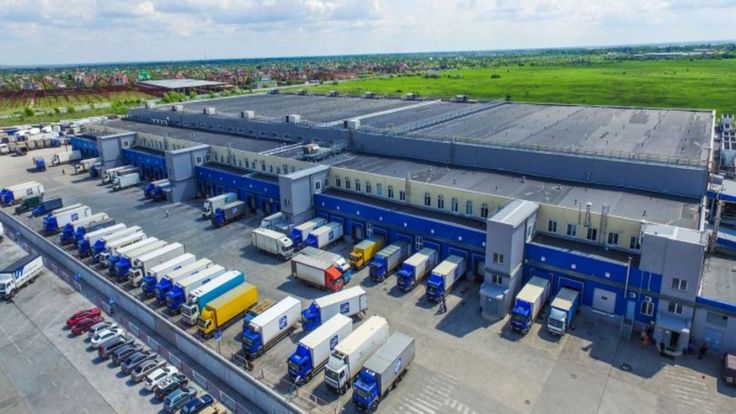
Above: A distribution yard on the Interstate 40 corridor. Most of the freight moving through Arkansas is handled at some point by a company with no ticker symbol.
Three Fortune 500 companies are headquartered within about thirty miles of one another in the northwest corner of Arkansas. A state of three million people hosts the largest retailer on earth, one of the largest meat processors in the United States, and one of the country's biggest trucking firms.
All three are publicly traded. Anyone with a brokerage account can own a piece of them before lunch.
What cannot be bought so easily is the economy that grew up around them: the third-party logistics firms, the cold-chain operators, the equipment makers, the agricultural technology companies and the software businesses built to serve a supply chain of that size. Almost none of them are listed anywhere.
Ouachita Private Markets, a Little Rock platform that began accepting applications this year, was built on that observation. It assembles diversified positions in privately held Arkansas companies and offers them at commitment sizes below the thresholds that have traditionally governed private investing.
The firm declined to identify specific holdings. Its executives will discuss the response, which they describe as heavier than anticipated and unusually concentrated among people who work in the industries concerned.
A Supply Chain, Not a Sector
Most states making this argument point to a single industry. Arkansas's case is structurally different: what it has is not one sector but a dense, interlocking set of businesses arranged around a few very large customers.
"Everyone looks at the three names on the interstate and stops there," said Louise Tremaine, managing director at Cache River Capital, which advises regional family offices. "The interesting companies are the ones those three buy from. They are smaller, they are private, and most of them have never taken a call from an outside investor."
That pattern is not unique to retail and freight. The state grows close to half of the nation's rice, and the businesses that dry, store, mill and ship it have consolidated into substantial private operations. Poultry works the same way.
The newest piece
The most recent addition is geological. Southern Arkansas sits on the Smackover Formation, a brine reservoir with commercially significant lithium content. ExxonMobil has drilled there; Standard Lithium, working with Equinor, has moved its own project toward production and signed an initial offtake agreement.
The majors are public companies. The service firms, drilling contractors and processing-technology businesses assembling around them largely are not — which is the same structure, repeated with a different commodity.
By the Numbers
~50%
of the United States rice crop is grown in Arkansas — more than any other state.
USDA · USA Rice
3
Fortune 500 headquarters sit within roughly thirty miles in the state's northwest corner.
Company filings
8,000 t/yr
first lithium offtake agreement signed from the Smackover Formation in south Arkansas.
Standard Lithium
The Case, and the Objection
The argument for widening access rests on a structural change nobody disputes. American companies stay private far longer than they once did, and a growing share of value creation now happens entirely outside public markets. An investor limited to listed equities is, increasingly, limited to a narrowing slice of the economy.
The objection is narrower and harder to dismiss. Private-market returns have historically been concentrated among a small number of managers with long-standing access to the best opportunities. Platforms arriving later tend to secure allocations further from that center — so broader access to the asset class does not automatically mean access to the same returns.
"Being close to an industry is not the same as understanding it as an investment. People conflate the two constantly, and it is expensive."Danielle Suh, Chief Investment Officer, Ridgeline Trust
Neither position can be settled yet. The structures in question are recent enough that no meaningful track record exists.
Where Investors Are Looking
| Sector | What sits inside it | |
|---|---|---|
| 01 | Logistics & Supply ChainInterstate 40 corridor | Third-party logistics operators, freight brokerages, warehouse automation and the software running it. Arkansas sits on a national freight artery, and the firms handling that volume are overwhelmingly private. |
| 02 | Food Production & AgribusinessDelta and northwest | Rice drying, milling and storage; poultry processing; cold-chain distribution. Revenue follows growing seasons rather than product cycles, which has kept much of the sector out of public markets. |
| 03 | Critical Minerals & LithiumSmackover Formation | Brine extraction technology, processing and the contractors building it out. The majors involved are listed; the specialist firms supplying them, for the most part, are not. |
| 04 | Steel & Advanced ManufacturingMississippi River corridor | Electric-arc steelmaking and the fabricators, tooling shops and component suppliers around it. Capital-intensive, contract-driven, and slower-moving than the other three. |
Investors Watching the Opportunity
Figures referenced in the broader conversation around private regional markets. Inclusion reflects participation in that discussion and does not indicate a holding in, or any relationship with, the program described in this article.
Alice Walton
Heiress to Walmart & Philanthropist
One of the world's wealthiest women, managing multi-billion dollar family assets and funding major art initiatives.
Roy Ellingson
Chief Executive, Pinnacle Cold Logistics
Runs a refrigerated distribution network across the Delta. Writes on capital access for mid-sized operators outside the coastal financial centers.
Danielle Suh
Chief Investment Officer, Ridgeline Trust
Oversees a long-horizon institutional portfolio with significant private allocations. A persistent skeptic of retail access claims.
Wendell Cross
Senior Fellow, Delta Policy Institute
Economist studying how industrial concentration in smaller states affects household investment access.
Why Arkansas Is Paying Attention
Arkansas's interest is not a matter of law or incentive. It is a matter of who lives there and what they do for a living.
An unusually large share of the state's workforce is employed inside supply chains of national scale — driving them, running the warehouses, processing the food, maintaining the equipment. Those are people with direct, daily knowledge of businesses whose value has compounded for two decades without any route for them to participate.
The northwest corner has also changed character. Two decades of corporate growth, followed by the arrival of the Crystal Bridges Museum of American Art in Bentonville, turned a rural county into a region that retains professionals rather than exporting them. That has produced a larger cohort of households with capital to allocate than the state's overall figures would suggest.
None of this creates special eligibility. Rules governing participation in private offerings are federal and apply the same way in Fayetteville as in Boston; prospective investors should confirm their own standing independently. What Arkansas has is proximity — of the industries, and of the people who work inside them.
- Freight
- A national trucking corridor and the private carriers, brokers and warehouses along it.
- Food
- Close to half the country's rice, plus one of the largest poultry economies in the United States.
- Minerals
- A lithium build-out in the south of the state, still early and still assembling suppliers.
- Steel
- Modern electric-arc capacity on the Mississippi River and the fabricators around it.
- Retention
- A northwest corner that now keeps its graduates instead of exporting them.
What Access Does Not Fix
Distribution is one problem. Risk is another, and the two are routinely presented as though solving the first addressed the second.
Liquidity is the binding constraint. Money committed to private holdings is typically unavailable for years, and secondary sales, where they exist at all, tend to clear below the carrying value. Valuation is the second: private positions are marked periodically, by methods that differ between managers, so a reported number can lag reality in either direction for a long time.
"The right question is not whether private markets have outperformed," said Wendell Cross of the Delta Policy Institute. "It is whether this investor, entering at this moment, through this structure, is positioned to receive any of it. Three separate questions, asked as one."
The direction of travel is not in dispute. The companies driving growth stay private longer than any generation before them, and pressure to widen participation follows from that fact rather than from any one firm's ambitions.
Whether the vehicles now being assembled are the right answer will take years of results to establish. What exists today is demand — steady, regional, and arriving faster than the industry expected.
Most Read in Business

Carriers Are Rebuilding Their Contracts Around Shorter Lanes
Regional routing is winning back volume from long-haul.

Rice Growers Weigh Storage Against a Softer Export Market
Drying capacity is the constraint nobody planned for.

Lithium Contractors Queue for Skilled Labor in the South
Wages are climbing before the first plant is finished.
Explore Your Investment Options
Tell us a little about yourself and the investment opportunity you're interested in.
Applications are reviewed individually.